Building Performance Regulations
In Massachusetts, building performance regulations are primarily governed by the state’s building energy codes and local emission ordinances, which are designed to enhance energy efficiency and reduce greenhouse gas emissions. There are two primary types of building performance regulations: Building Performance Disclosures and Building Performance Standards.
Building Performance Disclosures
These types of ordinances require annual disclosure of energy and water usage.
1
Annual Reporting
Building owners must report their building’s energy and water usage each year, often using tools like the ENERGY STAR Portfolio Manager.
Scope
Disclosure Only – requires large buildings to report their energy use.
Building Performance Standards
These types of ordinances require annual disclosure of energy and water usage with set emission reduction targets.
1
Annual Reporting
Building owners must report their building’s energy and water usage each year, often using tools like the ENERGY STAR Portfolio Manager.
2
Third-Party Verification
Reported data must be verified by a third party in the first reporting year and periodically thereafter.
3
Emissions Standards
Buildings must meet emissions reduction targets that become more stringent over time, aiming for significant reductions in greenhouse gas emissions. Non-compliance can result in penalties.
Scope
Disclosure + Emissions Reduction – requires large buildings to report their energy use and meet emissions reduction targets.
Review the Regulations
Statewide:
LBER stands for Large Building Energy Reporting
Start here:
Municipality Specific:
BERDO stands for Building Emissions Reduction and Disclosure Ordinance
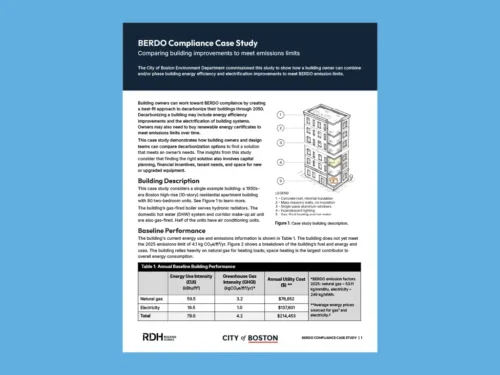
Boston BERDO Compliance Case Study
Case StudiesWhy this is important: This case study examines seven scenarios for Boston BERDO compliance in the context of an aging/end-of-life building enclosure and mid-life mechanical systems.
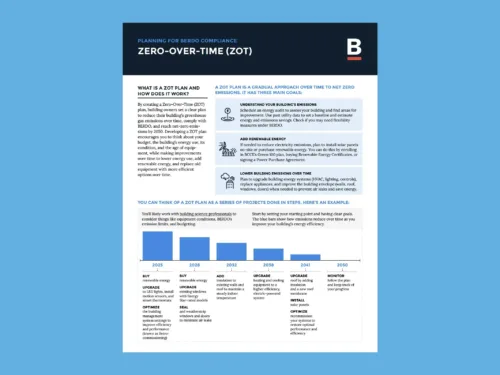
Zero-Over-Time (ZOT) Planning for Boston BERDO Compliance
Guides & How TosWhy this is important: Zero over Time planning allows building owners to plan their emissions reductions over time, comply with regulations, and optimize cost savings.
BEUDO stands for Building Energy Use Disclosure Ordinance
Start here:
BERDO stands for Building Emissions Reduction and Disclosure Ordinance
Start here:
Continue with these:
BEU-D stands for Building Energy Use Disclosure
Start here:
Continue with this:
Boston BERDO Compliance Workbook for Condos and Co-ops
Guides & How TosWhy this is important: For Boston condo associations and co-op owners, this workbook provides a step-by-step process on BERDO compliance and Zero-Over-Time planning.

Zero-Over-Time (ZOT) Planning for Boston BERDO Compliance
Guides & How TosWhy this is important: Zero over Time planning allows building owners to plan their emissions reductions over time, comply with regulations, and optimize cost savings.
Sample Zero-over-time Plan: Mid-rise Multi-family
ReportsWhy this is important: Learn how a mid-rise multifamily building plans for long-term Boston BERDO compliance through phased electrification.